About the book

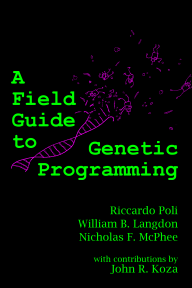
Robot with transparent background A Field Guide to Genetic Programming (ISBN 978-1-4092-0073-4) is an introduction to genetic programming (GP). GP is a systematic, domain-independent method for getting computers to solve problems automatically starting from a high-level statement of what needs to be done. Using ideas from natural evolution, GP starts from an ooze of random computer programs, and progressively refines them through processes of mutation and sexual recombination, until solutions emerge. All this without the user having to know or specify the form or structure of solutions in advance. GP has generated a plethora of human-competitive results and applications, including novel scientific discoveries and patentable inventions.

The book is freely downloadable under a Creative Commons license as a PDF and low cost printed copies can be purchased from lulu.com. This web site will be used for information relating to the book, and other pertinent announcements. We also have a discussion group for questions and conversation related to the book.
Showing posts with label thanks. Show all posts

Saturday, 19 September 2009

Thanks for the kind words about the Field Guide

We occasionally have the gratifying experience of stumbling across someone who's said something nice about the Field Guide out there on the Internet. Recently, for example, Bill came across this comment on GeneticProgramming.us

The Field Guide to Genetic Programming was compiled from numerous sources to reflect the current state and practice of Genetic Programming. This book is an invaluable asset to anybody interested in Genetic Programming. I highly recommend it. It is available for free online, but it certainly doesn't hurt to have a hard copy.
We greatly appreciate this sort of support. It's nice to know that people are finding the Field Guide useful, and are willing to spread the word. Many thanks to everyone who's put a little of their energy into our project.

Quite remarkably, the Field Guide continues to sell steadily on Amazon despite being freely available in multiple formats. Our sales rank on Amazon.com is (as of today) #198,789. This may not sound like much, but for a quite specific technical book in an area of computer science most people haven't heard of this is pretty darn excellent! A quick survey of some of the other heavy hitters in the EC book list shows that they're all ranked over 200K, with many much higher (like over 500K). That said, Melanie Mitchell's new Complexity: A guided tour (which is a general audience book) is ranked 2,981, which is a really excellent achievement - congratulations to Melanie!

If you're a reader of either the PDF or printed version and would like to lend a hand, feel free to leave a short review on something like Amazon - it's definitely appreciated.

Sunday, 30 March 2008

A huge thanks to all our proofreaders!

It takes a village to raise a book, and we were extremely fortunate to have an enthusiastic and talented pool of proofreaders. They went through the Field Guide, helping us finding the inevitable typos, and pointing out places where our presentation didn't sparkle quite as much as we thought it did. We spent almost all of the last week before we wrapped the book simply processing their many comments. While I'm sure we didn't address every one of their suggestions, there were hundreds of changes made based on that feedback, and there's no question that the book is better for their hard work and generous efforts.

To quote from the acknowledgements:


We had the invaluable assistance of many people, and we are very grateful for their individual and collective efforts, often on very short timelines. Rick Riolo, Matthew Walker, Christian Gagne, Bob McKay, Giovanni Pazienza, and Lee Spector all provided useful suggestions based on an early technical report version. Yossi Borenstein, Caterina Cinel, Ellery Crane, Cecilia Di Chio, Stephen Dignum, Edgar Galván-López, Keisha Harriott, David Hunter, Lonny Johnson, Ahmed Kattan, Robert Keller, Andy Korth, Yevgeniya Kovalchuk, Simon Lucas, Wayne Manselle, Alberto Moraglio, Oliver Oechsle, Francisco Sepulveda, Elias Tawil, Edward Tsang, William Tozier and Christian Wagner all contributed to the final proofreading festival. Their sharp eyes and hard work did much to make the book better; any remaining errors or omissions are obviously the sole responsibility of the authors.


Thanks again to everyone who helped us get the book out the door!